
Accounting & ERP Choices Sept 26
Brodie Stewart - Associate Director
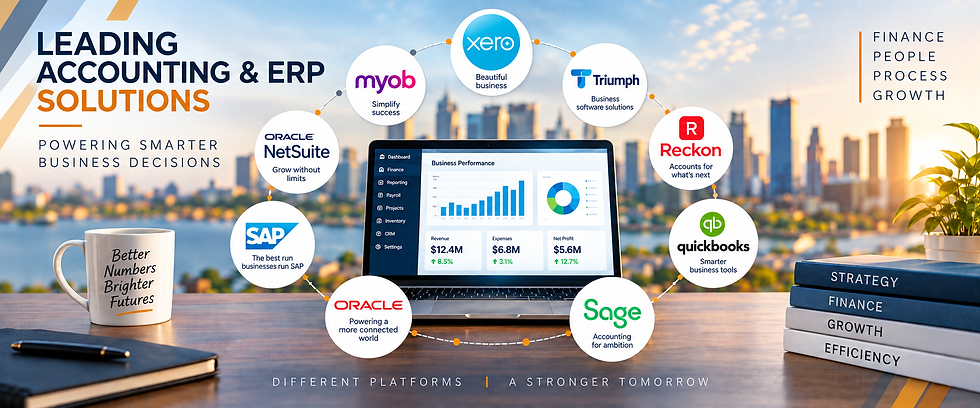
New software is Not the Solution you are seeking. Every few months another business owner changes accounting systems and ends up worse off than before they started.
The migration gets sold as a job that will take only a few weeks. You take out a subscription, import the chart of accounts and away you go. What actually happens is opening balances that will not agree from the old system to the new, a year of comparatives nobody can reconstruct, payroll configured wrong, bank feeds double-counting and a bookkeeper spending six months working around the system instead of reporting from it. BAS lodgements go out late. The owner then flies blind through exactly the period they were trying to get visibility on.
The error is treating it as an IT purchase rather than a finance project. Someone who has done a dozen of these will spend a day on scope before anything is switched on. What comes across, what stays behind, when the cutover happens, who signs off the first month. That day costs less than the six months that generally happens without planning.
The truth is that the software is not really the problem.
Most owners change systems hoping to finally understand their numbers, then set the new one up exactly like the old one. One revenue line. One wages line. One profit figure at the bottom.
That tells you the business made money. It does not tell you which part of the business is profitable and what is not.
A business running three divisions, four crews or two branches needs to see each of them on its own. The revenue, the direct costs that belong to it and the share of overhead it genuinely carries. Then job costing over the top, so actual hours and materials can be held against what was quoted.
Owners who put that in place routinely find one division has been quietly carrying another for years. Alternatively, it revealled that a whole category of work stopped being profitable when the input costs moved but the quoting assumptions did not.
The point of new software is not tidier bookkeeping. It is being able to answer, with numbers rather than instinct, which parts of the business are worth doing more of.
Changing accounting software requires a high level of accounting and systems knowledge, together with careful planning, appropriate resourcing and disciplined execution. It is a complex technical project, not simply an IT exercise.
In our role as Corporate Advisers, we have overseen numerous businesses undertaking this transition. Based on that experience, we have consistently observed:
With the right expertise and planning, the transition can be completed relatively seamlessly within a matter of weeks.
The appropriate accounting, systems and operational expertise must be involved from the outset.
An experienced specialist in accounting software implementation and data migration is essential.
A detailed implementation plan must clearly define responsibilities, timelines, dependencies and validation requirements.
All key stakeholders must be involved, including finance, operations, management and external advisers.
If the chart of accounts is being amended or optimised, it must be carefully designed to support the company’s reporting, operational and management information requirements.
Attempting to manage the process solely with internal staff who lack deep implementation and data-migration experience, is highly likely to produce a suboptimal outcome. The consequences can include inaccurate data, inefficient processes, unreliable reporting and significant business disruption lasting 12 to 18 months.
Trust us when we say, it is ultimately cheaper, faster and significantly less disruptive to invest in the right expertise and ensure the transition is completed properly the first time.
To discuss your specific situation, contact brodie.stewart@stratosfear.com.au


Comments